
What Is the CLIFF Money Mindset Compass?
A simple, research-backed assessment designed to help you understand how you think about money.
In just a few minutes, you’ll get clarity on:
- How you approach earning, saving, and spending
- Your comfort with risk and uncertainty
- The habits shaping your financial decisions
This isn’t about right or wrong answers.
It’s about understanding your default patterns.
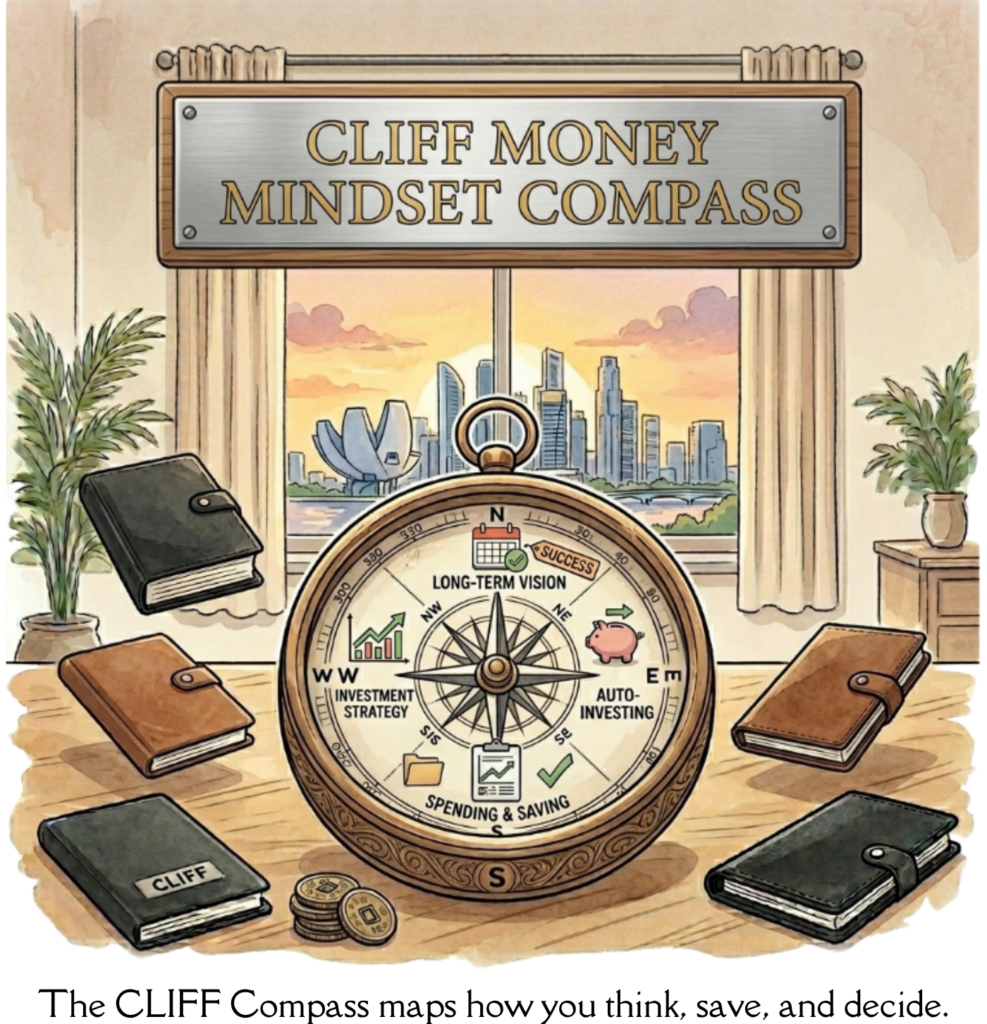
Why This Matters
Money mindsets are formed early and they quietly influence every financial decision you make.
Why some people save
consistently
Why others avoid
investing
Why financial stress
shows up
The CLIFF Compass helps you uncover these patterns—so you can understand them, and change them.
How It Works
Take the Assessment
Answer a short set of questions based on your instincts.
Discover Your Mindset
Get insights into how you think about money.
Apply the Insights
Use your results to make better, more confident decisions.
What You’ll Gain
Clarity Over Confusion
Understand why you make the financial choices you do
Better Decisions
Reduce second-guessing and act with confidence
Awareness of Patterns
Recognize habits that help—or hold you back
Practical Direction
Know what to change and where to start
FAQs
Frequently Asked Questions
While the money mindsets are the same at their core, younger people have different financial aspects in their lives – salaries, insurance, dependents and more. Hence a different set of questions helps unlock the mindset.
The CLIFF Money Mindset Compass is grounded in wellestablished research from behavioral finance, psychology, and financialliteracy studies. It draws on evidencebased frameworks such as Klontz & Britt’s Money Scripts Inventory, Shefrin & Thaler’s work on selfcontrol and mental accounting, and the CFPB’s Financial WellBeing Scale. It covers seven dimensions that span anxiety, restraint, status orientation, planning, protection, risk tolerance, and growth mindset with a psychometric approach of standardized rating scales, reversescore balancing, and multifactor scoring to drive reliability.
Your custom sheet will give you specific tips and strategies to consider, based on the book CLIFF. Also understanding your mindset around money is a key step to figuring out how to make it work for YOU.
No purchase is needed to take the assessment. But the book will give you context and a broad range of strategies and thinking that can help you in creating financial flexibility over a long life.
This is your self-reported information. We do not ask for your full name, and frankly you could put in any name and any email ID you wish. We ask for some optional information only to research if there are skews on some dimensions that would necessitate improvements in the assessment.
Clarity is the First Step
You don’t need a perfect plan
You need a better understanding

Newsletter
No content is added yet.