
Investing works. Even for those who get it wrong.
Here’s the proof.
Most people are so worried about getting their investing wrong that they keep putting it off. And that is the biggest mistake of all.
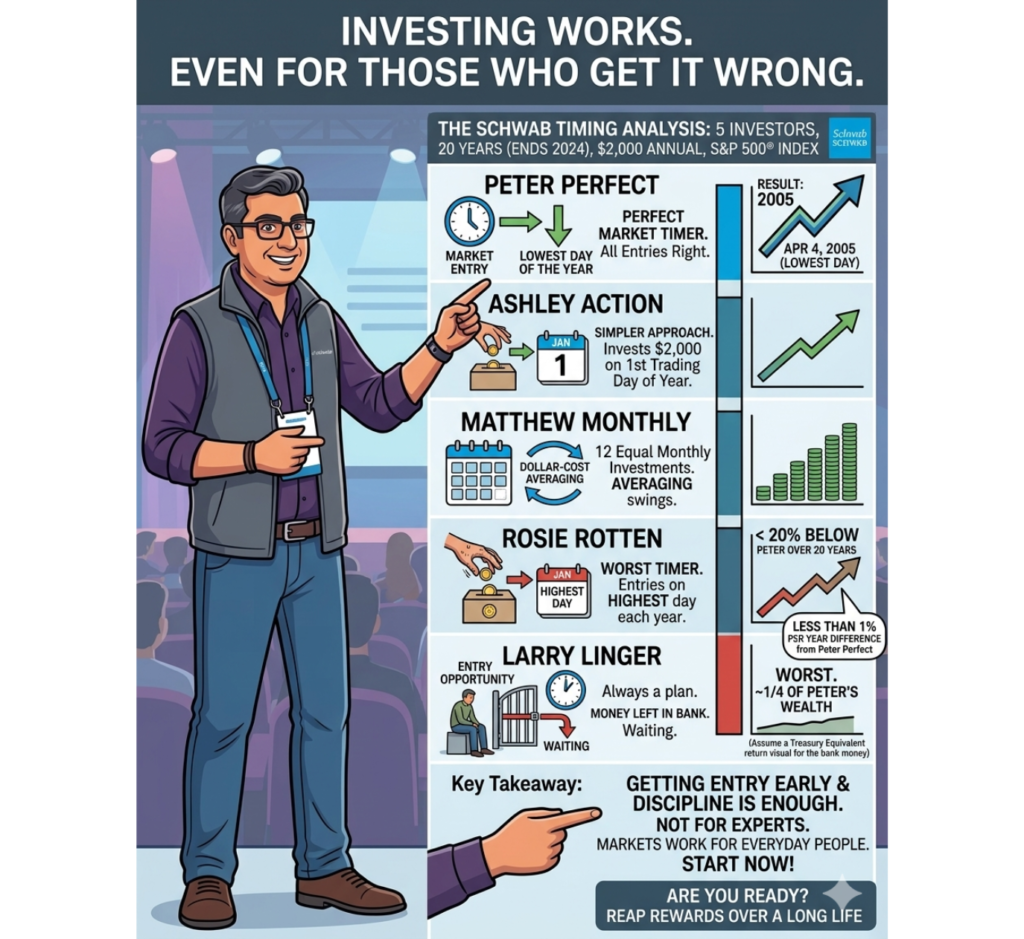
The team at Schwab did this analysis for 5 hypothetical investors. Each was given $2,000 at the beginning of every year for 20 years ending in 2024. Each invested in only the S&P 500® Index.
- Peter Perfect was the perfect market timer. He managed to get every market entry right in 20 years. Each year he got in on the lowest market day of the year. For instance in 2005, he invested on April 4, 2005, they day the S&P 500 was lowest for the year. This perfect timing happened every year for 20 years.
- Ashley Action took a simpler approach. Each year she invested her $2,000 as soon as she could – on the first trading day of the year. No further analysis or timing attempt.
- Matthew Monthly was a believer in averaging. He divided his annual $2,000 into 12 equal parts, which he invested at the beginning of each month. He believed this dollar-cost averaging would take care of market swings
- Rosie Rotten was the WORST TIMER. The opposite of Peter. She ended up investing on the highest market day in that year.
- Larry Linger was the one who always had a plan for the plan. He left his money in the bank. He was always convinced that the entry opportunity was just around the corner.
The results? While Peter naturally did the best over 20 years, even Rosie with her WORST timing was barely 20% below Peter over a 20 year period, or less than a difference of 1% a year. Larry, who stayed out of the markets did the worst. Even when we assume he got a treasury equivalent return on his money (usually higher than savings banks), he had around a quarter of what Peter had.
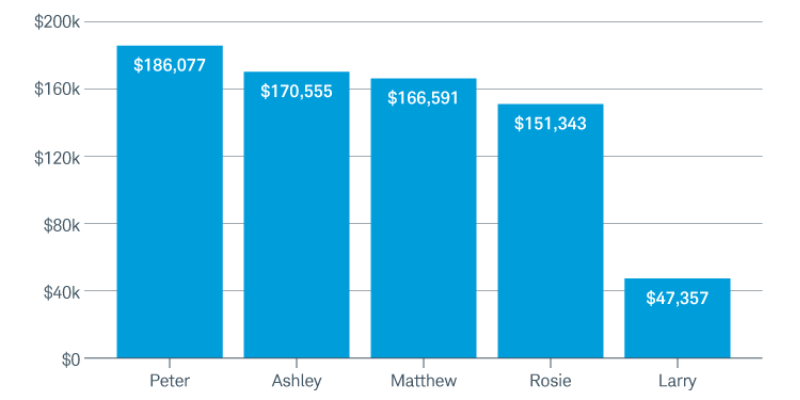
This analysis over multiple time periods yielded similar results. Getting in early gave similar returns as the best possible market timing, and beat waiting by a lot.
The takeaway is clear. Getting your entry early and with discipline and regularity is enough. You don’t need fancy strategies or a deep understanding of complex investing methods. It is not designed for experts. Markets work well for everyday people.
Are you ready? Start now, and reap the rewards over a long life.